> For the complete documentation index, see [llms.txt](https://docs.cortex.io/llms.txt). Markdown versions of documentation pages are available by appending `.md` to page URLs; this page is available as [Markdown](https://docs.cortex.io/ingesting-data-into-cortex/entities-overview/entities/adding-entities/teams/viewing-teams.md).
# Viewing teams
This article covers viewing teams in Cortex. For information on adding a team to Cortex, see [Adding teams](/ingesting-data-into-cortex/entities-overview/entities/adding-entities/teams.md). For information on adding users to teams and assigning roles, see [Team roles](/ingesting-data-into-cortex/entities-overview/entities/adding-entities/teams/team-roles.md). Refer to [Team ownership entity editing](/ingesting-data-into-cortex/entities-overview/entities/adding-entities/teams/team-entity-editing.md) for information on entity editing.
## Viewing the Teams catalog page
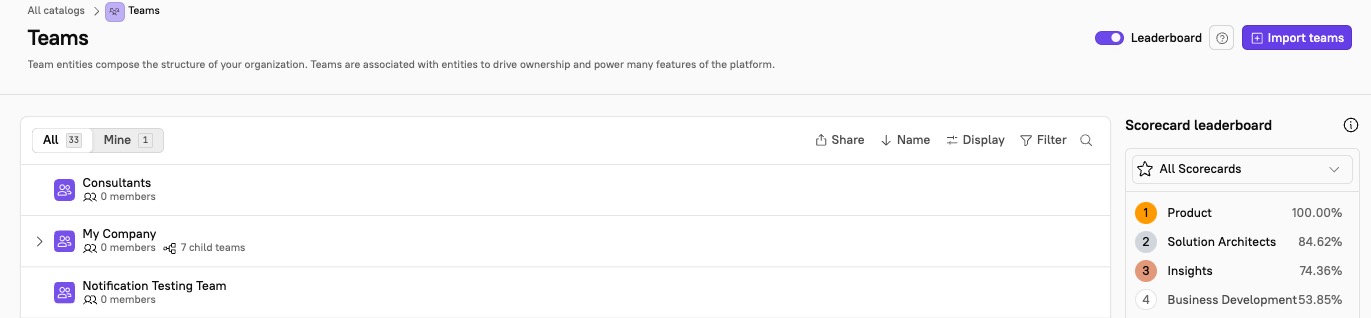
The **Teams** **catalog** page lists every team entity that's been added to Cortex. To open it, expand **Catalogs** in the main sidebar and select **Teams**. Each row shows the entity's name and number of team members.
{% hint style="info" %}
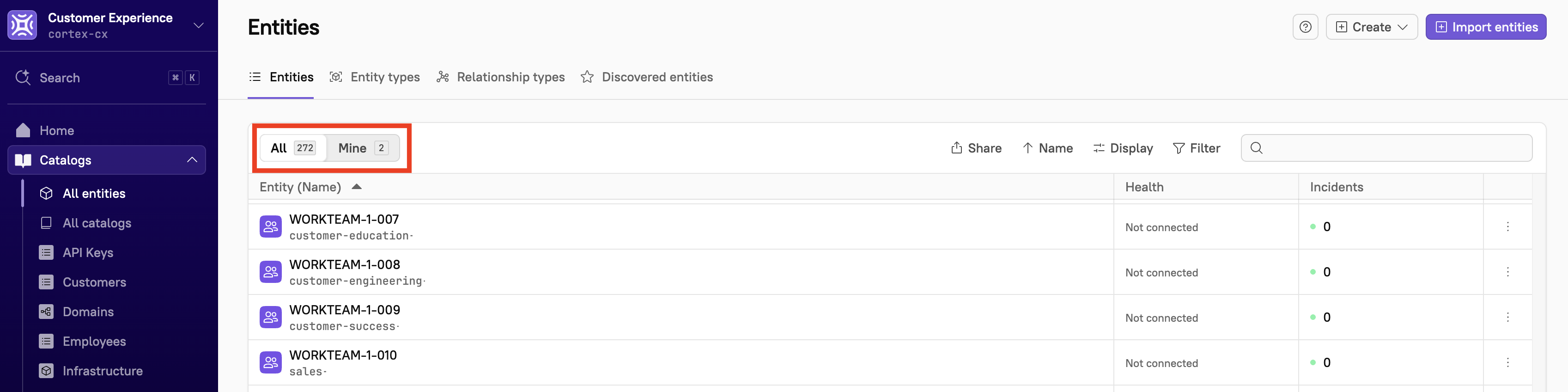
Select the **All** tab to view all entities. Select the **Mine** tab to view only entities where you are an owner or member. Cortex saves your selection and restores it the next time you open this page.
 {% endhint %}
### Searching across and filtering teams
There are several ways to search and filter your teams list.
1. From the main sidebar, expand **Catalogs**, then select **Teams.**
2. Do one of the following:
* Select the **All** tab to search and filter across all of your organization's teams.
* Select the **Mine** tab to search and filter only the teams you own.
* Note that Cortex saves your selection and restores it the next time you open this page.
3. Do any or all of the following:
* To find specific teams, use the search bar in the upper-right corner of the page and type to search. The search bar shows which fields you can search on and which field your query is matching. For more information, see [Using search in Cortex](/configure/settings/search.md#using-the-catalog-search-bar).
* Click **Name** to select whether you want to sort by name or identifier, and whether to sort by ascending or descending order.
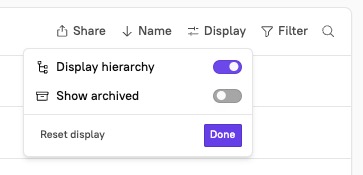
* Click **Display** to choose whether to show archived teams and/or display teams by hierarchy.
* Click **Filter** to narrow down your list by team, member, or group.
### Viewing team hierarchy
Follow the steps below to display teams in hierarchy.
1. From the main sidebar, expand **Catalogs**, then select **Teams.**
2. Click **Display** at the top of the teams list.
3. Toggle on **Display hierarchy**.
{% endhint %}
### Searching across and filtering teams
There are several ways to search and filter your teams list.
1. From the main sidebar, expand **Catalogs**, then select **Teams.**
2. Do one of the following:
* Select the **All** tab to search and filter across all of your organization's teams.
* Select the **Mine** tab to search and filter only the teams you own.
* Note that Cortex saves your selection and restores it the next time you open this page.
3. Do any or all of the following:
* To find specific teams, use the search bar in the upper-right corner of the page and type to search. The search bar shows which fields you can search on and which field your query is matching. For more information, see [Using search in Cortex](/configure/settings/search.md#using-the-catalog-search-bar).
* Click **Name** to select whether you want to sort by name or identifier, and whether to sort by ascending or descending order.
* Click **Display** to choose whether to show archived teams and/or display teams by hierarchy.
* Click **Filter** to narrow down your list by team, member, or group.
### Viewing team hierarchy
Follow the steps below to display teams in hierarchy.
1. From the main sidebar, expand **Catalogs**, then select **Teams.**
2. Click **Display** at the top of the teams list.
3. Toggle on **Display hierarchy**.
4. Click **Done**.
{% hint style="info" %}
You can also view the hierarchy for a given team on its [entity details page](/ingesting-data-into-cortex/entities-overview/entities/details.md).
{% endhint %}
#### Understanding hierarchies
Cortex lets you structure teams to reflect your organization's real hierarchy, whether you're creating teams manually or importing them. Any team can be both a parent to other teams and a child of another, so multi-level structures are fully supported.
The Teams catalog page displays individual and parent teams by default. An arrow next to a team's name indicates it has children; click to expand and view child teams.
In the image below, `My Company` is a parent team with 7 child teams nested under it.
### Viewing the Scorecard leaderboard
On the right side of the Teams catalog page is the Scorecard leaderboard, which highlights the 10 best-performing teams within your organization.
The leaderboard is calculated from the average of [Scorecard](/standardize/scorecards.md) scores for all entities owned by a team. Change in rank is based on the team's score 7 days ago. You can use the drop-down to select a different Scorecard, allowing you to view the leaderboard based on specific Scorecards.
{% hint style="success" %}
The leaderboard gamifies entity quality and encourages team members to achieve goals. This creates a culture of accountability, where everyone has visibility into how they're performing.
{% endhint %}
## Viewing an individual team's page
Every team has a dedicated details page displaying its key information. Follow the steps below to access a team's details page.
1. From the main sidebar, expand **Catalogs**, then select **Teams.**
2. Select a team to view its individual page.
On the team's details page, you’ll find the following:
* The [entity details sidebar](/ingesting-data-into-cortex/entities-overview/entities/details.md#configuring-the-entity-details-sidebar)
* The [team name and tag](/ingesting-data-into-cortex/entities-overview/entities/details.md#locating-an-entitys-unique-identifiers)
* The main **Overflow menu** icon and the **Configure entity** button
* The **Overview** tab:
* The **Team members** section
* Includes a list of all team members, their roles, and their emails. When available, Cortex pulls in profile photos from your Git provider.
* The **Scorecards** section
* An overview of how the team is performing across Scorecards. By default, the snapshot shows the level that the team’s entities have reached in each Scorecard. Optionally, click the arrow next to This entity only to include entity's children.
* The **Latest events** section
* A list of recent events associated with this team, such as alerts from [PagerDuty](/ingesting-data-into-cortex/integrations/pagerduty.md).
* The **Entities** tab:
* Shows a list of linked entities, including number of incidents and health status. Click into an entity to learn more about it. Optionally, click the **Overflow menu** to copy the entity to your clipboard or view the entity in the relationship graph.
* The [metadata sidebar](/ingesting-data-into-cortex/entities-overview/entities/details.md#configuring-the-entity-metadata-sidebar)