> For the complete documentation index, see [llms.txt](https://docs.cortex.io/llms.txt). Markdown versions of documentation pages are available by appending `.md` to page URLs; this page is available as [Markdown](https://docs.cortex.io/improve/eng-intelligence/dashboards/custom.md).

# Custom Dashboards

{% hint style="info" %}
Custom Dashboards is available to all customers as a Public Beta feature. You can provide us [feedback here](https://forms.gle/xazu6auWuMGqMKRt7).
{% endhint %}

Custom Dashboards make it easy to create shared views of the key engineering metrics that matter most to your organization. They allow you to:

* Aggregate and display multiple metrics: Combine different saved report modules into a single dashboard.
* Personalize views: Create dashboards tailored to specific teams or use cases, enabling focused monitoring.
  * For example, you might want to track specific incident response metrics or you oculd create a comprehensive view of delivery by combining metrics across deployment, version control, and project management systems.
* Share insights: Share dashboards within your organization, ensuring your stakeholders have access to relevant information without manual reporting.
* Drive action: By surfacing the trends that matter to you, dashboards help you identify bottlenecks, track progress toward goals, and make data-driven decisions.

<figure><img src="/files/YrtAwxV5oK30RaumrS8R" alt="" width="563"><figcaption></figcaption></figure>

## Create a Custom Dashboard

### Prerequisites

Before getting started:

* Make sure you have configured metric modules and saved them in Metrics Explorer.
* You must have the `Configure Eng Intelligence` permission.

### Add modules to the dashboard

1. Navigate to **Eng Intelligence > Dashboards**. In the upper right corner, click **Create Dashboard**.
2. Enter a name and description and choose an icon, then click **Create Dashboard**.
3. Select an existing metric module to add to your dashboard.
   * To create a new module, click **Create module**. You will be redirected to the Metrics Explorer where you can configure a metric then save it as a module. You will need to navigate back to the Dashboards page to create a Custom Dashboard that contains your newly-created module.
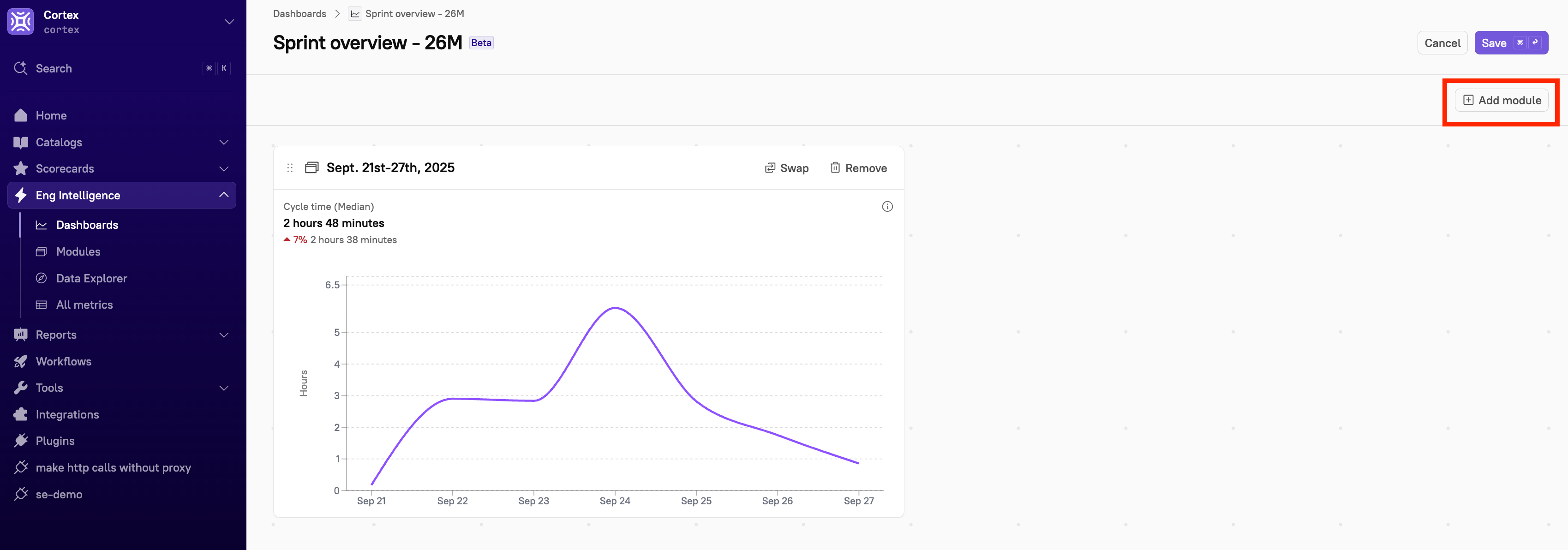
4. After selecting a module, you are redirected back to the dashboard. To add more modules, click the **+** icon on the right or below the module you added.\\

   <div align="left"><figure><img src="/files/MvUKfr9FGC7R9Bmntv7L" alt="Click the + at the bottom or right side of the module." width="563"><figcaption></figcaption></figure></div>

## Managing Custom Dashboards

### Share a Custom Dashboard

Dashboards are automatically visible within your organization to users with the `View Eng Intelligence` permission, so everyone can view the same insights and stay aligned.

To create a share link to send to another user, click the 3 dots icon in the upper right, then click **Share**.

<div align="left"><figure><img src="/files/GRbujTHNcd9ITswWg9P9" alt="Click the 3 dots icon then click Share." width="257"><figcaption></figcaption></figure></div>

### Edit a Custom Dashboard

While viewing the dashboard, click **Edit** in the upper right corner. Go through the steps of [adding modules to the dashboard](#create-a-custom-dashboard), then click **Save**.

## Custom Dashboard examples

See examples of Custom Dashboards below:

<details>

<summary>Delivery Health Dashboard</summary>

Create a dashboard for visibility into how work is flowing across teams. Combine deployment frequency with Jira-based metrics like work items completed, story points delivered, and cycle time to measure delivery throughput and identify bottlenecks.

<figure><img src="/files/mrgFjxMc9VmFoHbebNYV" alt="A custom dashboard is set up to show delivery health."><figcaption></figcaption></figure>

</details>

<details>

<summary>Incident Response Dashboard</summary>

Create a dashboard to measure the effectiveness of your incident response process. Monitor time to resolution and incident frequency, while correlating with contributing factors such as deployment frequency and PR size to uncover root causes.

<figure><img src="/files/lKUaqCXJFt1TVkxt6jrQ" alt="A custom dashboard is set up to show incident response metrics."><figcaption></figcaption></figure>

</details>

<details>

<summary>Reliability Dashboard</summary>

Create a dashboard to track the health of your services beyond MTTR. Monitor resolution time, incident frequency, change failure rate, and rollback frequency to understand trends of stability and resilience in your systems.

<figure><img src="/files/zHP4bTkFC9wWZhys4Kdk" alt="A custom dashboard is set up to show reliability metrics."><figcaption></figcaption></figure>

</details>


---

# Agent Instructions
This documentation is published with GitBook. GitBook is the documentation platform designed so that both humans and AI agents can read, navigate, and reason over technical content effectively. Learn more at gitbook.com.

## Querying This Documentation
If you need additional information that is not directly available in this page, you can query the documentation dynamically by asking a question.

Perform an HTTP GET request on the current page URL with the `ask` query parameter, and the optional `goal` query parameter:

```
GET https://docs.cortex.io/improve/eng-intelligence/dashboards/custom.md?ask=<question>&goal=<endgoal>
```

`ask` is the immediate question: it should be specific, self-contained, and written in natural language.
`goal` is optional and describes the broader end goal you are ultimately trying to accomplish on behalf of the user. GitBook uses it to tailor the answer towards what is most useful for that goal.

The response will contain a direct answer to the question and relevant excerpts and sources from the documentation.

Use this mechanism when the answer is not explicitly present in the current page, you need clarification or additional context, or you want to retrieve related documentation sections.