

- You can launch an AI Governance Scorecard. Cortex provides an AI Governance template in-app, which can be modified based on your organization’s needs.
- You can launch an Initiative associated with the Scorecard, which gives your engineers a deadline for when to complete certain goals.
- Use reports and Cortex MCP to better understand progress and next steps.
Create an AI Governance Scorecard
Step 1: Create the Scorecard and configure its basic settings
- On the Scorecards page in your workspace, click Create Scorecard.
- On the
AI Governancetemplate, click Use. - Configure basic settings, including the Scorecard’s name, unique identifier, description, and more.
- Learn about configuring the basic settings in the Creating a Scorecard documentation.
Step 2: Review and modify rules
Cortex’s templated rules are based on common industry standards:AI Governance: Bronze level rules
AI Governance: Bronze level rules
- Secrets scanning and management
git.fileExists(".github/workflows/*") AND git.codeSearch(query = "secret", fileExtension = "yml").length > 0 - PR reviews required from two or more reviewers
git.branchProtection().numReviewsRequired > 1 - AI security documentation and guidelines
git.fileExists("AI-SECURITY.md") OR git.fileExists("docs/ai-security.md") OR git.fileExists("docs/AI_USAGE_POLICY.md") OR git.fileExists("RESPONSIBLE_AI.md") - Dependency vulnerability scanning
git.fileExists(".github/workflows/*") AND (git.codeSearch(query = "dependabot", fileExtension = "yml").length > 0 OR git.codeSearch(query = "safety", fileExtension = "yml").length > 0 OR git.codeSearch(query = "snyk", fileExtension = "yml").length > 0) - PR reviews from CODEOWNERS
git.branchProtection().codeOwnerReviewsRequired == "true" - AI service configuration security
git.fileExists("AI-SERVICE-CONFIGURATION-POLICY.md")
AI Governance: Silver level rules
AI Governance: Silver level rules
- Mitre ATLAS matrix
custom("owners-reviewed-mitre-atlas-matrix") == "true" - Monitoring and alerting for AI applications
datadog.monitors().filter((monitor) => monitor.name.matches(".*ai.*|.*model.*|.*ml.*")).length > 0 - Automated security testing in CI/CD
git.fileExists(".github/workflows/*") AND (git.codeSearch(query = "security", fileExtension = "yml").length > 0 OR git.codeSearch(query = "sast", fileExtension = "yml").length > 0 OR git.codeSearch(query = "container.*scan", fileExtension = "yml").length > 0) - Data privacy and PII protection measures
git.fileExists("PRIVACY.md") OR git.fileExists("DATA-HANDLING.md") OR git.fileExists("docs/privacy.md") OR git.codeSearch(query = "PII", fileExtension = "md").length > 0 - AI model access controls and authentication
git.fileExists("AI-MODEL-ACCESS-CONTROLS.md") - External AI vendor risk assessment
git.fileExists("AI-VENDORS.md") OR git.fileExists("APPROVED-AI-SERVICES.md") OR git.fileExists("docs/ai-vendor-security.md")
AI Governance: Gold level rules
AI Governance: Gold level rules
- Incident response plan for AI security
git.fileExists("AI-INCIDENT-RESPONSE.md") OR git.fileExists("docs/ai-incidents.md") OR git.codeSearch(query = "ai.*incident|model.*breach", fileExtension = "md").length > 0 - Standford NLP version
packageVersion("stanfordnlp") >= semver("4.5.10") - AI ethics and bias testing framework
git.fileExists("ETHICS.md") OR git.fileExists("BIAS-TESTING.md") - AI security training and awareness documentation
git.fileExists("AI-TRAINING.md") OR git.fileExists("docs/ai-security-training.md") OR git.codeSearch(query = "training|awareness|security.*guideline", fileExtension = "md").length > 0 - No secret scanning vulnerabilities
git.numOfVulnerabilities(source=["GITHUB_SECRET_SCANNING"]) == 0 - Adversarial attack detection and prevention
git.fileExists("ADVERSARIAL-TESTING.md") OR git.codeSearch(query = "tests/*adverserial*").length > 0 - No critical vulnerabilities
git.numOfVulnerabilities(severity=["CRITICAL"]) == 0 - AI compliance and regulatory documentation
git.fileExists("AI-COMPLIANCE.md") OR git.fileExists("NIST-AI-RMF.md") OR git.fileExists("docs/ai-governance.md") OR git.codeSearch(query = "compliance|regulation|gdpr|nist", fileExtension = "md").length > 0 - Open NLP version
packageVersion("opennlp") >= semver("2.5.5")
Create an AI Governance Initiative
Follow the steps below to create an Initiative:Create an AI Governance Initiative
Create an AI Governance Initiative
To motivate change by a certain deadline, you can create an Initiative:
- While viewing your AI Governance Scorecard, click Create Initiative in the upper right.
- Configure the Initiative fields, including a descriptive name so your team members understand the purpose of the Initiative. For example,
Complete Bronze level AI Governance rules by end of quarter.- Make sure to enable notifications so users are notified if an entity they own is failing the Initiative’s goal.
- Save the Initiative.
Measuring success
To understand progress of your Scorecard:- Ask Cortex MCP, “How is my AI Governance Scorecard doing?” The MCP will respond with information on the entities that are failing rules and suggested next steps.
-
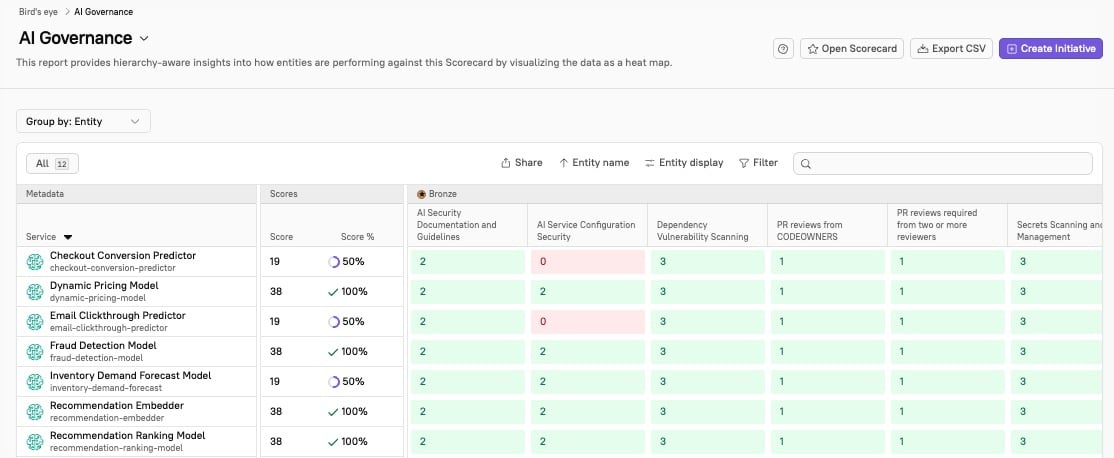
Review reports: The Bird’s Eye report gives insight into how entities are performing against the Scorecard by visualizing the data as a heat map:
- MTTR: With best practices in place, such as incident response plans and AI security runbooks linked, you should see faster incident response.
- Incident frequency: You may see less incidents overall with the implementation of rules such as requiring more than one PR review and proactively ensuring there are no critical vulnerabilities.